F1 2026 Rules Explained: A Beginner's Guide to Formula 1's New Era
Smaller, lighter cars. Half the power from electricity. Moving wings, no DRS, and an 11th team on the grid. Here's every major F1 2026 rule change explained in plain English, and what it means on track.
With only six races left in the 2026 season, starting with the United States Grand Prix in Austin on 25 October, the championship is into its final stretch. Even this late in the year, the new rules are worth a refresher. Whether you've followed every round or are only now tuning in for the title run-in, here's a reminder of the technical regulations that have shaped this season, and that will shape 2027 too.
Every few years, Formula 1 tears up its rulebook.
2026 was the biggest reset in a generation. New engines. New fuel. New aerodynamics. Wings that move on every straight. And a car that is smaller, lighter and more electric than anything F1 has raced before.
If you've been watching this season and wondering why drivers talk about "Boost", why the wings open by themselves, or where DRS went, this guide is for you. Here's every major F1 2026 rule change, explained in plain English.
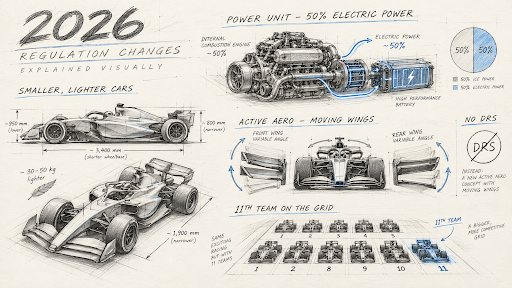
2026 F1 Regulation Changes Explained Visually: Power unit 50/50 split, active aero moving wings, lighter dimensions, and Cadillac 11th team (Click to zoom)
The F1 2026 rules at a glance
| Area | 2025 (Previous Era) | 2026 (New Era) |
|---|---|---|
| Power split | About 80% combustion, 20% electric | About 50% combustion, 50% electric |
| Electric motor (MGU-K) | 120 kW (~160 hp) | 350 kW (~470 hp) – Nearly tripled |
| MGU-H (Exhaust heat recovery) | Yes (High complexity & cost) | Removed completely |
| Fuel | Partly sustainable (10% E10) | 100% Advanced Sustainable Fuel |
| Engine manufacturers | 4: Mercedes, Ferrari, Renault, Honda | 5: Mercedes, Ferrari, Honda, Audi, Red Bull Ford |
| Overtaking aid | DRS (Rear wing flap only) | Overtake Mode (+0.5 MJ electrical boost) |
| Moving aerodynamics | Rear wing flap only (DRS zones when chasing) | Front and rear wings: Straight Mode & Corner Mode |
| Wheelbase | 3,600 mm | 3,400 mm (200 mm shorter) |
| Minimum car weight | 800 kg | 768 kg (32 kg lighter) |
| Teams on the grid | 10 teams (20 cars) | 11 teams (22 cars) – Cadillac joins |
| Budget cap | US$135 million | US$215 million (PU cap: US$130m) |
The goal behind it all: closer racing, more road-relevant engines, and a sport that runs on sustainable fuel.
The new power units: half electric
The engine is still a 1.6-litre turbocharged V6. Almost everything around it has changed.
- About 400 kW from combustion, 350 kW from electricity. The electric motor, the MGU-K, nearly triples in power from 120 kW. Together they produce more than 700 kW — roughly 1,000 horsepower — now split close to 50/50.
- The MGU-H is gone. This complex unit recovered energy from the turbocharger's exhaust heat. Removing it cuts cost and complexity, making it far easier for new automotive giants to join Formula 1.
- More energy recovered. The battery can harvest more than double the energy per lap it could before, primarily under heavy braking.
The simpler, more road-relevant formula drew new names. Audi is the headline arrival: it took over Sauber to enter F1 as a full works team, building its own car and engine for the first time. Honda now partners Aston Martin, and Red Bull builds its own engines in collaboration with Ford. Ferrari and Mercedes continue, Renault has stepped away with Alpine switching to Mercedes customer power, and General Motors is due to join as an official engine supplier from 2029.
100% sustainable fuel
Every car now runs on Advanced Sustainable Fuel, synthesized from sustainable non-fossil sources rather than crude oil. It is designed as a "drop-in" fuel — meaning it burns in high-performance internal combustion engines without requiring re-engineering — which is why global carmakers see this technology as directly transferable to the hundreds of millions of road cars in service worldwide.
The new driver tools
With half the power now electric, managing battery state-of-charge is as critical to racecraft as tyre degradation. Drivers have four major controls in their cockpit arsenal:
Straight Mode and Corner Mode
Both the front and rear wings now move actively. In designated zones marked by "SM" boards beside the circuit, the wings flatten into Straight Mode to slash aerodynamic drag. Before turning into braking zones, they snap back to Corner Mode to restore maximum downforce and grip.
The crucial difference from DRS: Straight Mode is available to every car, on every lap, regardless of whether a driver is chasing a rival or circulating in clean air.
Overtake Mode
This replaces DRS as the primary tool for attacking. Track marshals place one detection point per lap. A driver running within one second of the car ahead at that detection point receives an extra 0.5 MJ of electrical energy to deploy on the subsequent lap.
Boost
The full-power deploy button on the steering wheel. Drivers can deploy stored battery energy whenever they choose — to mount an attack, defend an inside line into a hairpin, or nail a qualifying flying lap — either in one sustained burst or metered around the lap.
Recharge
Drivers and race engineers select between aggressive recharge engine-braking maps that harvest energy under deceleration. Mismanage the harvest strategy, and the battery runs flat mid-straight right when a rival pulls out of the slipstream.
Smaller, lighter, nimbler cars
Modern F1 machinery had grown increasingly bulky and heavy. The 2026 regulations aggressively downsized the chassis:
- Shorter: The wheelbase is cut by 200 mm, down to 3,400 mm.
- Narrower: The floor is 100 mm narrower, reducing overall width to 1,900 mm.
- Lighter: The minimum car weight drops 32 kg, falling from 800 kg to 768 kg.
- Narrower tyres: Front Pirelli tyres are 25 mm narrower, and rears are 30 mm narrower.
The underbody aerodynamics underwent a radical overhaul as well. The gigantic Venturi ground-effect floor tunnels of 2022–2025 were eliminated. Wings are simplified, aerodynamic wheel covers were discarded, and modern bargeboard flow conditioners returned to direct turbulent wake away. The outcome: cars that pivot sharply through tight chicanes and follow one another through fast sweepers with substantially reduced "dirty air".
A bigger grid and new qualifying
- 11 teams, 22 cars: Cadillac joined as Formula 1's 11th team — the championship's first brand-new squad since Haas arrived in 2016. Concurrently, Audi officially made its works debut after taking over Sauber.
- Qualifying adjusted: With 22 cars competing, Q1 (18 minutes) and Q2 (15 minutes) now each knock out six cars instead of five. Q3 remains a 13-minute shootout for the top 10 pole position contenders.
- New start procedure: Because the MGU-H was removed, the turbocharger relies solely on hot exhaust gas to spool up. Once the final car takes its grid slot, drivers receive a rev-up warning giving them five seconds to build boost before the five red lights illuminate.
A bigger budget cap
The baseline team cost cap rises from US$135 million to US$215 million, reflecting inflation adjustments and broader scope, while power unit manufacturers operate under a separate US$130 million engine cost cap (up from US$95 million).
What the 2026 rules mean for sim racers
For anyone who straps into a racing simulator, the 2026 rules make modern Formula 1 significantly more dynamic, rewarding, and tactical to drive.
Energy management has transitioned into an art form. Knowing precisely when to deploy Boost, when to lift-and-coast to recharge, and how to defend without draining your battery reserve teaches genuine telemetry discipline. Lighter, more reactive cars also reward true racing fundamentals: progressive trail braking, smooth steering inputs, and disciplined traction control on corner exits.
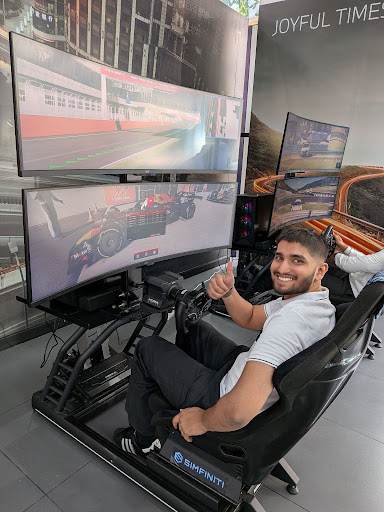
A driver mastering F1 car handling on a Simfiniti dual ultrawide direct-drive racing cockpit (Click to zoom)
EA Sports introduced an official 2026 season expansion for F1 25, bringing the new technical regulations, active aerodynamics, and updated grids directly into the hands of esports drivers worldwide.
The best way to understand any rulebook is to drive it.
Frequently asked questions
What are the biggest F1 rule changes for 2026?
New power units with a roughly 50/50 split between combustion and electric power, 100% sustainable fuel, moving front and rear wings, the end of DRS, and smaller, lighter cars.
Is DRS still used in F1 in 2026?
No. DRS has been replaced by Overtake Mode, which gives a chasing car extra electrical energy, and Straight Mode, which opens the wings for every car on designated straights.
How much power does a 2026 F1 car have?
More than 700 kW, roughly 1,000 horsepower, with about 400 kW from the V6 engine and 350 kW from the electric motor.
How much does a 2026 F1 car weigh?
The minimum weight is 768 kg, 32 kg lighter than in 2025.
How many teams are in F1 in 2026?
Eleven. Cadillac joined as the 11th team, taking the grid to 22 cars, and Audi replaced Sauber as a full works team.
Read the rules, then drive them
The 2026 rulebook asks more of drivers than ever: more tactical decisions, more energy to balance, and more opportunities to win or lose position on a single straight.
We will be breaking down each facet of the regulations across this series — from internal combustion and battery chemistries to active aerodynamics and cost caps. But nothing explains high-downforce physics like feeling the steering weight resist your hands as you tip into a 250 km/h apex.
If you would like to experience the thrill of racing — whether you are a seasoned motorsport addict or someone curious about clocking that very first flying lap — Simfiniti is your gateway.
Visit www.simfiniti.com • Follow @sim.finiti on Instagram
Try a race. Feel the difference. Experience Endless Play.
Sources & References:
- Formula 1 Official Technical Regulations & Explainer: 12 Rule Changes You Need to Know in 2026
- Formula 1 Beginner's Guide: The Beginner's Guide to the 2026 Regulations
- Mercedes-AMG Petronas F1 Team: Power Unit Regulation Changes
- EA Sports Official Announcement: 2026 FIA Formula One World Championship Season Expansion