Inside an F1 Steering Wheel: What Every Button Does
An F1 steering wheel weighs about 1.3 kg, can cost as much as a luxury car, and carries around 25 controls a driver uses at 300 km/h. Here's what the paddles, buttons and rotaries do, and what changed on the wheel for F1's new 2026 rules.
In your car, a steering wheel turns the front wheels.
In a Formula 1 car, it runs the race.
Gear changes, brake balance, battery energy, radio calls, the pit lane speed limiter and, since 2026, the moving wings: almost everything a driver controls passes through the small carbon-fibre rectangle in their hands. And they work it while cornering at speeds that would leave most of us gripping the seat.
Here's what's on an F1 steering wheel, what each control does, and what changed for the 2026 season.
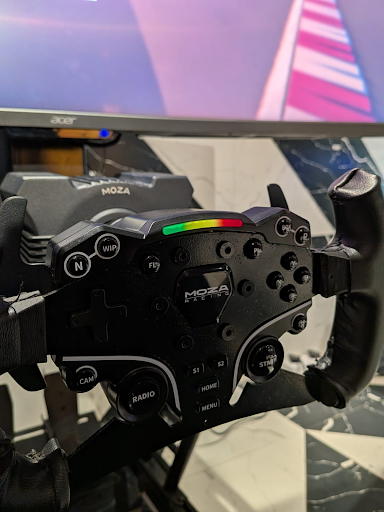
Paddle shifters on a Simfiniti direct-drive racing wheel
An F1 steering wheel by the numbers
| Metric | Specification |
|---|---|
| Weight | About 1.3 kg, electronics included |
| Controls | Around 25 buttons, rotary switches and paddles |
| Estimated cost | US$40,000 to $100,000, roughly ₹35 lakh to ₹85 lakh |
| Wheels per driver | Typically three to five a season |
| Build | Carbon-fibre shell, with grips moulded to the driver's hands |
No team publishes an official price, so treat the cost as an industry estimate. Each team designs its own wheel, and each driver's version is shaped around their hands and preferences.
Why is an F1 steering wheel shaped like a rectangle?
Because an F1 driver never needs to turn it very far. The steering is quick and direct, so even the tightest hairpin needs only a fraction of a full turn. Cutting away the top and bottom of the rim saves weight, frees space in a tight cockpit, and leaves room for the screen and controls.
The controls sit where a driver's thumbs and fingers can reach them without letting go. At racing speed, there's no time to look down for long.
During my time working on vehicle dynamics with Ferrari and Maserati, the geometry of the rim was always engineered backwards from human biomechanics: when steering effort peaks at 20 Nm or more under aerodynamic load, hand slip is never an option. The rectangular yoke locks the driver's wrists into the exact leverage plane required.
The paddles behind the wheel
Reach behind the rim and you'll find the paddles:
- Gearshift paddles. Right paddle for upshifts, left for downshifts. There's no gear lever and no clutch pedal.
- Clutch paddles. Two smaller paddles, used mainly at the race start and when pulling away from a pit stop. The driver releases them to launch the car smoothly.
The buttons and rotaries on the front
Every team lays out its wheel differently, and every driver has their own preferences. Most wheels carry versions of these controls:
| Control | What it does |
|---|---|
| Pit limiter | Holds the car at the pit lane speed limit, so the driver can stay flat out on the throttle without a penalty. |
| Radio | Opens the communication line to the race engineer. |
| Neutral | Selects neutral, used when stopping in the pit box or parking the car. |
| Drink | Pumps water from a bottle in the car through a tube in the driver's helmet. |
| Brake balance | Shifts braking force between the front and rear axles, often several times a lap. |
| Differential | Rotary switches that change how the rear wheels share power on corner entry, mid-corner and exit. |
| Power unit modes | Rotaries that choose how hard the engine and battery work, from full attack to saving fuel. |
| Multifunction & OK | A rotary that opens extra settings, and a button to confirm a change or acknowledge the engineer. |
In the middle sits an OLED screen showing gears, lap times, delta warnings and, since 2026, the battery's state of charge and aerodynamic status.
2026 F1 Steering Wheel Guide: Key buttons, dials, screen readouts and controls (Hover and click or tap to zoom)
What's new on the 2026 F1 steering wheel?
The 2026 rules gave drivers new tools, and the wheel changed with them (for a full explainer on engines, aerodynamics, weight and the 11th team, see our guide to F1 2026 rules explained):
DRS is gone
The Drag Reduction System, which opened a flap in the rear wing for a chasing car, has been retired after 15 seasons. Its button now does new jobs.
Straight Mode
Both front and rear wings now move. On designated straights, the driver switches into Straight Mode, flattening the wings to cut drag. Unlike DRS, it's available to every driver, every lap, whether or not they're chasing anyone. The wings return to Corner Mode, their high-downforce setting, for the corners.
Overtake Mode
This is the new tool for attacking. A driver who is within one second of the car ahead at the detection point gets an extra 0.5 MJ of electrical energy to use for an overtake.
Boost
The full-power button. Drivers can use stored battery energy whenever and wherever they like, to attack or defend, either in one burst or spread across a lap.
Recharge
Working with their race engineer, drivers choose from recharge modes that recover energy under braking and from the engine. With roughly half the car's power now electric, managing the battery is as important as managing the tyres.
One lap through a driver's hands
To see how it all comes together, follow a driver down a long straight into a heavy braking zone:
- Exit the corner. Thumb on Boost to deploy battery energy as the car straightens up.
- Hit the straight. Switch to Straight Mode. The wings flatten and the car surges forward.
- Chasing a rival? If they were within one second at the detection point, Overtake Mode brings extra energy for the attack.
- Brake. The wings snap back to Corner Mode for grip. Left paddle, clicked several times, for downshifts. The car recovers energy as it slows.
- Mid-corner. A quick twist of a rotary or a nudge of brake balance if the car is sliding.
- Radio. A message from the engineer about tyres or energy. Tap OK to acknowledge.
All of that happens in a few seconds, while the driver is pulling heavy g-forces and fighting for position.
How does a simulator wheel compare?
You don't need 25 buttons to drive your first lap on a Simfiniti simulator. You do get the most important part of the experience: the feel.
Our direct-drive wheelbases send the forces of the virtual car straight into your hands. You feel the front tyres load up in a corner, the kerbs rattle through the rim, and the rear start to slide before it breaks traction. Paddle shifters behind the wheel handle gear changes, just as they do in a real race car.
That's where most people start to understand why F1 drivers obsess over every detail of their wheel. It's their main connection to the car.
Want to try it for yourself? Visit one of our venues in Hyderabad, or bring the experience to your next event with our Hire Packages.
Frequently asked questions
How much does an F1 steering wheel cost?
Teams don't publish official prices, but industry estimates put a wheel at US$40,000 to $100,000, roughly ₹35 lakh to ₹85 lakh, depending on the team and its custom electronics.
How many buttons are on an F1 steering wheel?
Around 25 controls in total, across buttons, rotary switches and paddles. The exact layout varies by team and driver preferences.
How much does an F1 steering wheel weigh?
About 1.3 kg, including its carbon-fibre structure, electronics, rotary dials and screen.
Do F1 cars still have DRS in 2026?
No. DRS was retired at the end of 2025. Drivers now use Straight Mode (active aero), Overtake Mode and Boost instead.
Why do F1 drivers take the steering wheel off?
The wheel is removable using a quick-release mechanism so drivers can climb in and out of the tight cockpit quickly. It is also an FIA safety requirement: a driver must be able to evacuate the car in five seconds.
The most expensive thing a driver holds
An F1 steering wheel is a computer, a radio, a gear selector and a set of wing controls, all in a frame you could hold in one hand.
The tech is extraordinary. But the feeling it delivers — the car talking through your fingertips — is something you can experience for yourself.
Experience Direct-Drive Steering Feel
If you'd like to experience the thrill of racing — whether you're a seasoned motorsport addict or someone curious about that first lap — Simfiniti is your gateway.
Visit: www.simfiniti.com • Follow @sim.finiti on Instagram • Try a race. Feel the difference. Experience Endless Play.